How AI Is Making IPTV Smarter in 2026: What It Means for Your Viewing Experience
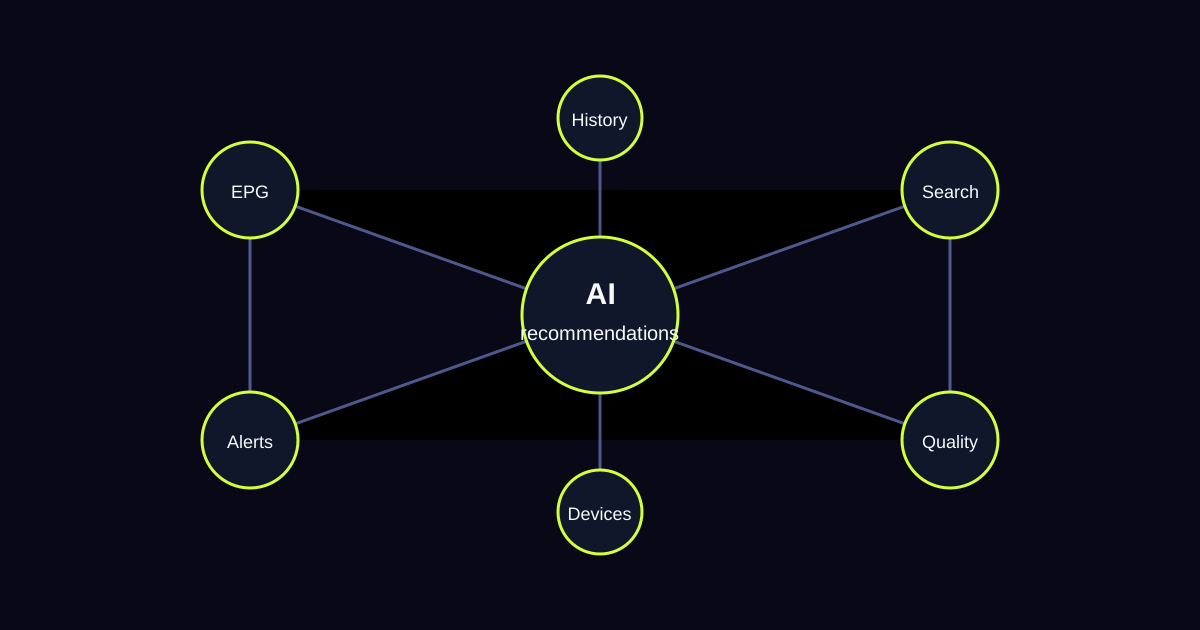
Artificial intelligence entered the IPTV ecosystem slowly — first as a marketing term attached to basic algorithmic recommendations, then as a genuine engineering layer reshaping how streams are delivered, quality is managed, and content is discovered. By mid-2026, AI components are embedded in the infrastructure of most large-scale IPTV providers, and the effects are visible to subscribers in measurable ways: faster channel switching, fewer buffering events, and more relevant content surfaced automatically.
This article breaks down what AI is actually doing inside IPTV services in 2026, what the practical improvements look like from a subscriber perspective, and where the technology is headed in the next twelve months.
What Does AI Actually Do Inside an IPTV Service?
The phrase "AI-powered IPTV" covers three genuinely distinct functions: content delivery optimisation, quality adaptation, and content recommendation. Each operates at a different layer of the service and affects your experience in different ways.
Content delivery optimisation uses machine learning models trained on historical traffic data to predict demand for specific channels at specific times. When 40 million people simultaneously tune to a World Cup match on a single channel, the delivery network must distribute that load across servers in real time. AI models predict these demand spikes minutes or hours before they occur and pre-position cached stream copies on edge servers closest to subscriber locations. The result is that channel-switching latency drops and the initial buffering that once occurred when a popular match kicked off is significantly reduced. Akamai, the largest CDN used by IPTV providers, reported in Q1 2026 that AI-driven predictive caching reduced peak-load buffering events by 34% compared to reactive caching approaches.
Quality adaptation goes beyond the standard adaptive bitrate (ABR) streaming used since the early 2010s. Traditional ABR measures your current bandwidth and adjusts video quality in steps. AI-enhanced quality adaptation models analyse bandwidth trend patterns — not just current speed but predicted speed over the next 15–30 seconds — and switches quality proactively rather than reactively. For live sports, where a 2-second quality drop during a goal moment is noticeable, proactive adaptation delivers a more consistent experience than reactive systems. Studies from streaming infrastructure company Conviva showed that AI-enhanced ABR reduced visible quality switches during live events by 41% in 2025 trials across 12 IPTV platforms.
How Is AI Changing Channel Discovery and Search?
Channel discovery is one of the most frustrating aspects of traditional IPTV. A large playlist is effectively unusable without search and filtering tools. Basic IPTV players require you to know what you are looking for before you can find it. AI-powered search changes this by enabling natural language queries and semantic matching.
In 2026, several premium IPTV apps have integrated voice search and natural language processing into their interfaces. A user can say "find Spanish football" or "show me French cinema channels" and the AI layer parses the intent, maps it to channel categories and EPG data, and returns relevant results within one second. This is a qualitatively different experience from scrolling through a flat list of large channel names.
The underlying technology uses the same large language model families as general-purpose AI assistants — specifically smaller, distilled versions that run efficiently on the ARM processors inside Firestick and Android TV devices. TiviMate 5.x, expected in Q3 2026, is widely reported to include an AI-assisted search layer. IPTV Smarters Pro already includes a keyword search feature that uses semantic expansion to return results for related terms.
What Is AI Doing to Improve Stream Reliability?
Stream reliability — the absence of freezing, pixelation, and disconnection — is the single most important quality metric for IPTV subscribers. AI is being applied at two points in the delivery chain to improve reliability: at the server infrastructure level and at the client (app) level.
Server-side AI monitoring continuously analyses stream health metrics across all active channels in a provider's playlist. Channels that develop issues — packet loss, bitrate instability, DNS failures — are flagged automatically and traffic is redirected to backup streams or alternative source servers within seconds. Without AI monitoring, a failing channel might remain in a degraded state for minutes before a human engineer notices and intervenes. Automated monitoring that runs at millisecond intervals catches degradation events that would be invisible to human operators.
Client-side AI in apps works differently. Apps like TiviMate and IPTV Smarters have implemented logic that monitors playback health locally and automatically switches to a backup stream URL when a threshold number of rebuffering events occurs within a defined window. More advanced implementations use pattern recognition to predict when a stream is likely to fail based on early warning signals — sustained high rebuffering frequency, declining bitrate, increasing packet loss — and switch before the stream actually drops.
Can AI Personalise My IPTV Experience?
Personalisation is where AI in IPTV is most nascent. The core challenge is that IPTV services do not track viewing behaviour the way Netflix or Spotify do. A standard IPTV playlist does not know which channels you watch, for how long, or what you prefer. Without behavioural data, personalised recommendations are impossible.
Some IPTV providers are beginning to implement opt-in viewing data collection on their platforms — watching which channels are accessed most frequently and building basic preference profiles per subscriber. This data is then used to promote relevant channels in the interface — surfacing sports channels at 3 p.m. on a Saturday, or moving your frequently watched news channels to the top of the playlist during news events.
The implementation in 2026 is basic compared to what video streaming platforms do, but the direction is clear. As IPTV apps mature and providers invest in subscriber-side data infrastructure, personalisation will become more sophisticated. The privacy-conscious approach — local on-device profiling without server-side data transmission — is the model most likely to be adopted by apps on privacy-focused platforms.
What AI Features Should I Look for When Choosing an IPTV Provider?
When evaluating IPTV providers in 2026, AI-related questions to ask are:
Does the provider use multiple server locations with edge caching? Providers using CDN infrastructure with AI-driven load balancing typically have significantly better peak-time performance than single-server or two-server providers.
Is there automatic failover to backup streams? Backup stream switching — even if not explicitly labelled as AI — indicates that the provider's infrastructure has automated monitoring and rerouting. Ask support whether backup URLs are automatically activated or require manual selection.
Does the app support EPG data? An EPG (electronic programme guide) is the foundation for any future AI-powered content discovery. Providers that do not offer EPG data are structurally incapable of delivering smarter content navigation.
LumIPTV uses stream-health monitoring, backup workflows, and EPG data where available. See the feature comparison and test the categories you care about before choosing a paid plan.
The AI Roadmap for IPTV in the Next 12 Months
The twelve months from June 2026 to May 2027 will see the most significant AI integration in IPTV's history. The key developments to watch:
Natural language app control — voice commands for channel switching, recording, and search — will ship in major app updates. TiviMate 5.x and IPTV Smarters Pro 6.x both have AI voice layers in development.
AI-generated programme guides — automatically categorising and describing every channel in a playlist using LLM-based metadata generation — will reduce the dependence on provider-supplied EPG data and fill gaps for channels that currently show no guide information.
Predictive quality switching at the client level will become standard across premium apps, reducing the brief freeze that still occurs during traditional ABR quality drops.
The trajectory is clear: IPTV in 2027 will feel meaningfully different from IPTV in 2024. The channels will be the same, but the intelligence around navigation, delivery, and quality management will have advanced substantially.
Try LumIPTV free and experience what AI-enhanced IPTV infrastructure already delivers in 2026.
Tired of buffering, dropouts, or poor channel quality?
Try LumIPTV on your own device first. Free 24h trial, no credit card, and 3-day money-back support if you subscribe.